
Summary
A Georgia store may be responsible for a parking lot injury when the store controlled the area, knew or should have known about a dangerous condition, failed to use ordinary care, and that failure caused your injury. In other cases, the responsible party may be the shopping center owner, landlord, property manager, maintenance contractor, or another entity that controlled the parking lot.
Common hazards can include potholes, cracked pavement, broken curbs, damaged wheel stops, standing water, debris, poor drainage, inadequate lighting, defective ramps, and unsafe pedestrian routes. Liability is not automatic because an injury happened outside a business. The facts often turn on who controlled the location, what that party knew or should have known, how long the hazard existed, whether a reasonable inspection should have found it, and whether you could reasonably have recognized and avoided the danger.
If you were hurt in a store parking lot in Atlanta, GA, the location of the hazard and the property agreements can matter as much as the hazard itself. Gunnels Law Firm, LLC can review the circumstances, identify potentially responsible parties, and explain how Georgia premises liability law may apply.
Key Point: A parking lot injury claim often depends on control, knowledge, causation, and the evidence showing what the property looked like when you were hurt.




How Georgia Premises Liability Law Applies to Store Parking Lots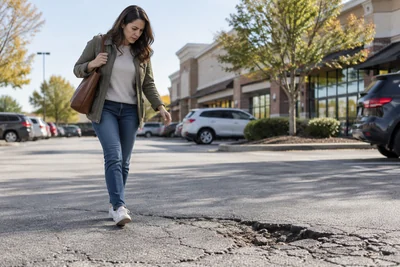
Georgia premises liability law generally requires an owner or occupier of land to use ordinary care to keep the premises and approaches safe for people who are lawfully invited onto the property. This duty is stated in O.C.G.A. § 51-3-1.
When you visit a grocery store, retail shop, pharmacy, restaurant, or shopping center as a customer, you are generally an invitee. A property owner or occupier may have a duty to address dangerous conditions within areas it owns, occupies, or controls.
A store does not necessarily control every part of a shopping center parking lot. Georgia courts have distinguished between areas controlled by a tenant and common parking areas controlled by a landlord or shopping center owner. That distinction can determine which party owed you a duty.
Potential parking lot hazards include:
- Deep potholes
• Cracked or uneven pavement
• Broken curbs
• Damaged wheel stops
• Loose gravel
• Poor drainage
• Standing water
• Debris in walking paths
• Inadequate lighting
• Defective stairs or ramps
• Unsafe pedestrian routes
• Poorly maintained entrances
You can learn more about related premises liability issues here:
https://gunnelslaw.com/atlanta-slip-and-fall-lawyer/



The Store May Not Be the Only Responsible Party
One of the first questions after a parking lot injury is who owned, occupied, maintained, or controlled the location where you were hurt.
You may assume that the store owns and maintains the parking lot. In many shopping centers, that is not the case. A store may lease its retail space while a separate property owner or landlord controls the common parking area. A property management company may supervise the property, and contractors may handle paving, lighting, drainage, cleaning, or repairs.
Depending on the facts, potentially responsible parties may include:
- The retail store
• The property owner
• The shopping center owner
• A landlord
• A property management company
• A maintenance company
• A paving or repair contractor
• Another entity that created or controlled the hazard
Control is a fact-specific issue. A store can be responsible for some areas while a landlord or another entity is responsible for others.
Lease documents, maintenance agreements, inspection records, repair invoices, surveillance footage, photographs, and witness statements can help show which party had responsibility for the area.

I had the pleasure of working against Chris on a fairly complicated case. Chris was professional during the course of litigation, and undoubtedly maintained his clients’ interests as the primary focus throughout. Due to Chris’ efficiency and advocacy for his clients, we were able to resolve the case for a reasonable amount, without spending unnecessary time and expenses. I hope to have more cases with Chris in the future, and would have no hesitation recommending Chris to handle complex personal injury matters.”
- Paul T.
What Must You Prove in a Georgia Parking Lot Injury Claim?
A parking lot injury does not automatically make a store or property owner legally responsible.
In a typical premises liability claim, you generally need evidence showing:
- A dangerous condition existed.
• The defendant owned, occupied, or controlled the area or otherwise had a legal duty concerning the hazard.
• The defendant had actual or constructive knowledge of the dangerous condition.
• You lacked equal or superior knowledge of the hazard under the circumstances.
• The dangerous condition caused your injury.
• You suffered legally recoverable damages.
Georgia premises liability cases often focus heavily on knowledge.
Actual knowledge may exist when an owner, employee, manager, landlord, or maintenance worker knew about the hazard before your injury. Prior complaints, repair requests, incident reports, or employee observations may help establish actual knowledge.
Constructive knowledge can arise when the facts support a finding that the hazard should have been discovered through reasonable inspection or that an employee was in a position to see and correct the condition. The length of time the hazard existed can be relevant.
For example, a pothole that developed over time near a heavily used entrance may raise different questions from debris that appeared only moments before an accident.
Why Inspection and Maintenance Records Matter
Inspection and maintenance records can help show what a business or property manager did before your injury.
Records may answer questions such as:
- When was the parking lot last inspected?
• Who was responsible for inspections?
• Were inspections documented?
• Had anyone reported the hazard?
• Was a repair request submitted?
• Did a contractor inspect or repair the area?
• How long had the condition existed?
• Were similar incidents reported before your injury?
A defendant may argue that there was no reasonable opportunity to discover a hazard. Prior complaints, photographs, inspection records, repair requests, or evidence that the condition developed over time may support a different conclusion.
Preserving this evidence promptly can matter because records can be lost, surveillance footage can be overwritten, and the condition itself can change.
Related Videos
Dealing with Insurance
Steps to File a Lawsuit
What If the Store Says You Should Have Seen the Hazard?
A store, property owner, or insurance company may argue that you knew about the condition or could have avoided it through ordinary care.
That issue depends on the circumstances.
A large pothole in a clear, well-lit area may present different facts from a pavement defect hidden by shadows, parked vehicles, landscaping, standing water, or poor lighting. Your attention may also be reasonably directed toward moving vehicles, shopping carts, pedestrians, or traffic in a busy retail parking lot.
Georgia courts generally examine whether the injured person used the care that an ordinarily prudent person would use under the circumstances. The fact that a hazard was visible does not always end the analysis.
Georgia’s comparative fault statute can also affect compensation. Under O.C.G.A. § 51-12-33, damages can be reduced according to your percentage of fault. If you are found 50 percent or more responsible for the injury, you cannot recover damages under that statute.
What Evidence Should You Preserve After a Parking Lot Injury?
Parking lot conditions can change quickly. Asphalt can be repaired, debris can be removed, lighting can change, weather can alter the scene, and video may be overwritten.
When you can do so safely, potential evidence may include:
- Photographs of the hazard
• Wide-angle photographs showing the surrounding area
• Video of the accident location
• Images showing lighting and visibility
• Measurements of a hole, crack, curb, or pavement height difference
• Surveillance footage
• Witness names and contact information
• Incident reports
• Inspection logs
• Maintenance records
• Prior complaints
• Repair records
• Medical records
• Photographs of visible injuries
• Shoes and clothing worn at the time of the incident
If you need medical care, your medical records can document the injuries that were diagnosed and the treatment you received.
You can also review common mistakes that may affect a slip and fall claim here:
https://gunnelslaw.com/mistakes-to-avoid-after-a-slip-and-fall/
Do Warning Signs Protect a Store From Liability?
A warning sign can affect a premises liability claim, but a sign does not automatically eliminate liability.
The issue is whether the warning was adequate under the circumstances and whether it reasonably alerted you to the specific danger. The location, visibility, wording, timing, and relationship between the warning and the hazard can all matter.
Questions may include:
- Could you see the warning before reaching the hazard?
• Was the warning present before the incident?
• Did it identify or reasonably alert you to the actual danger?
• Was it blocked by vehicles, displays, landscaping, or another obstruction?
• Was the dangerous area marked, closed, or restricted?
• Did the warning give you a reasonable opportunity to avoid the hazard?
You can read more about warning signs and slip and fall claims here:
https://gunnelslaw.com/how-warning-signs-impact-slip-and-fall-claims/
What If a Vehicle Causes the Parking Lot Injury?
Some parking lot injuries involve a driver rather than a dangerous property condition.
A driver may strike you while backing out of a parking space, turning through a lane, speeding through the lot, or failing to yield. Those facts may support a motor vehicle negligence claim.
Some incidents involve more than one cause. Poor lighting, an unsafe pedestrian route, obstructed visibility, and a negligent driver may all be relevant. In that situation, identifying every potentially responsible party can help determine which insurance policies and legal claims may apply.
What Compensation May Be Available?
The value of a parking lot injury claim depends on the evidence, the severity of your injuries, the available insurance coverage, the degree of fault assigned to each party, and the losses caused by the incident.
Depending on the facts, recoverable damages may include:
- Emergency medical treatment
• Hospital expenses
• Physician visits
• Physical therapy
• Future medical expenses supported by the evidence
• Lost income
• Loss or reduction of earning capacity
• Pain and suffering
• Physical limitations
• Scarring or disfigurement
• Other accident-related expenses supported by the evidence
There is no standard settlement amount for a parking lot injury. A claim involving short-term treatment will be evaluated differently from a claim involving a fracture, traumatic brain injury, spinal injury, surgery, permanent impairment, or long-term medical care.
You can learn more about factors that may affect a slip and fall claim here:
https://gunnelslaw.com/slip-and-fall-case-value/
How Long Do You Have to Bring a Georgia Parking Lot Injury Claim?
Georgia law generally requires an action for personal injury to be brought within two years after the right of action accrues. O.C.G.A. § 9-3-33 contains the general two-year limitation period for personal injury actions.
That deadline does not mean that you should delay an investigation. Surveillance recordings may be overwritten far sooner. Witnesses may become difficult to locate. Employees may change jobs. Repairs can permanently alter the accident scene.
Some cases can involve different deadlines, tolling rules, or special notice requirements. Claims involving a government entity can also require additional procedures. An attorney can review the facts and determine which deadlines apply to your situation.
How Can an Attorney Help With a Parking Lot Injury Investigation?
A parking lot injury claim may involve several businesses, insurers, contracts, and property records.
An attorney can investigate issues such as:
- Who owned and controlled the parking lot
• Whether a lease assigned maintenance duties to a landlord or tenant
• Whether a property manager or contractor had responsibility for the area
• Whether surveillance footage exists
• Whether prior complaints or incidents were documented
• Whether inspection procedures were followed
• Whether repair records show earlier notice of the condition
• Whether a driver or another party contributed to the incident
• Which insurance policies may apply
• Whether comparative fault is being asserted against you
Legal counsel can also communicate with insurers and preserve evidence before it disappears.
For more information about personal injury claims in Atlanta, GA, visit:
https://gunnelslaw.com/personal-injury-attorney-atlanta-ga/
Speak With an Atlanta, GA Injury Attorney
If you were injured because of a dangerous condition in a store parking lot in Atlanta, GA, Gunnels Law Firm, LLC can review the circumstances and explain the legal options that may be available. The firm offers free consultations for people who want to discuss a potential personal injury claim.
Call (770) 766-4484.
Clickable phone link:
tel:+17707664484
You can also request a consultation here:
https://gunnelslaw.com/contact-us/
This article is for general informational purposes only and is not legal advice. Every case is different. Reading this article does not create an attorney-client relationship. You should consult a qualified attorney about your specific circumstances.