
Yes. If you were injured in a multi-car pileup in Georgia, you may be able to recover compensation when another driver, or more than one driver, caused the crash. These cases can involve several drivers, competing accounts of what happened, and multiple insurance policies.
Georgia follows a modified comparative negligence rule. Under O.C.G.A. § 51-12-33, an injured person who is less than 50 percent at fault may still recover damages, but the amount may be reduced according to that person’s percentage of fault. If the injured person is 50 percent or more at fault, recovery may be barred.
Gunnels Law Firm, LLC helps people in Atlanta, Georgia, and nearby areas understand how liability, insurance coverage, evidence, and damages may affect a multi-vehicle accident claim.




Why Multi-Car Pileup Claims Are More Complicated 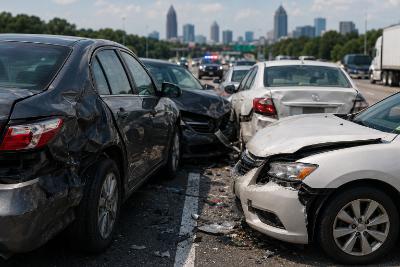
A multi-car pileup often begins with one collision and quickly becomes a chain reaction. One vehicle may rear-end another, push it into a third car, and cause additional drivers to collide while trying to stop or avoid the crash. In other situations, several drivers may make separate driving errors that contribute to the same accident.
The key legal question is not only which vehicle made contact first. The larger issue is whose conduct caused or contributed to the sequence of collisions.
Examples of conduct that may contribute to a pileup include:
- Speeding
• Following too closely
• Unsafe lane changes
• Distracted driving
• Failing to maintain a proper lookout
• Failing to react reasonably to traffic conditions
Because several drivers may give different accounts of what happened, these claims often require a close review of physical evidence, witness statements, vehicle damage, video, and other records.
You can learn more about Georgia car accident claims here:
https://gunnelslaw.com/atlanta-car-accident-lawyer/
Can More Than One Driver Be Liable?
Yes. More than one driver can share responsibility for a Georgia multi-car accident.
For example, imagine that Driver A is following too closely and rear-ends Driver B during heavy Atlanta traffic. Driver B is pushed forward. Driver C is approaching too fast while looking at a phone and then crashes into the back of Driver B, worsening the collision and injuries.
Depending on the evidence, both Driver A and Driver C could share responsibility.
The exact percentages of fault can affect the amount of compensation available. Georgia’s modified comparative negligence rule allows damages to be reduced according to the injured person’s share of fault. If the injured person is 50 percent or more responsible, recovery may be barred.
Fault allocation can become especially significant when several drivers contributed to the same pileup.
A police report can be useful evidence, but it does not always resolve every liability issue. Insurance companies may also reach different conclusions about who caused the crash.
More than one driver can be responsible for the same pileup, and more than one insurance policy may need to be evaluated before a claim is resolved.



Evidence That Can Help Prove What Happened
Evidence is often the foundation of a multi-car pileup claim. The more vehicles involved, the more likely drivers and insurers are to disagree about the sequence of events.
Useful evidence may include:
- Police crash reports and diagrams
• Photographs and video from the scene
• Vehicle damage patterns
• Dashcam footage
• Nearby business or traffic camera footage
• Witness statements
• Medical records
• Cell phone records when legally obtainable and relevant
• Event data recorder information from involved vehicles
• Skid marks, debris patterns, and roadway evidence
• Accident reconstruction analysis in more complex cases
Photos taken soon after the crash may help show where vehicles came to rest, which parts of the vehicles were damaged, and whether road or traffic conditions played a role.
Witnesses may also remember details that the drivers could not see from inside their own vehicles.
More information about preserving evidence after a crash is available here:
https://gunnelslaw.com/collecting-evidence-in-a-car-accident-claim/
I had the pleasure of working against Chris on a fairly complicated case. Chris was professional during the course of litigation, and undoubtedly maintained his clients’ interests as the primary focus throughout. Due to Chris’ efficiency and advocacy for his clients, we were able to resolve the case for a reasonable amount, without spending unnecessary time and expenses. I hope to have more cases with Chris in the future, and would have no hesitation recommending Chris to handle complex personal injury matters.” - Paul T.
What Compensation May Be Available?
If another driver caused your injuries, a Georgia car accident claim may seek compensation for losses connected to the crash. The damages available depend on the facts of the case and the evidence supporting each claimed loss.
Potential compensation may include:
- Past medical expenses
• Future medical expenses
• Lost income
• Reduced future earning ability
• Physical pain and suffering
• Emotional distress
• Loss of enjoyment of life
• Property damage
• Other accident-related out-of-pocket expenses
A serious pileup can create medical costs that continue long after the vehicles have been removed from the road. Some injuries require surgery, rehabilitation, physical therapy, follow-up care, or extended time away from work.
For that reason, evaluating a claim only by looking at bills from the first few days or weeks after the accident may leave future losses unaddressed.
An attorney may review medical records, employment information, insurance coverage, and other evidence to identify losses that may be included in the claim.
Dealing with Insurance Steps to File a LawsuitRelated Videos
How Insurance Coverage Works in a Multi-Car Accident
Insurance issues can become more complicated when several vehicles are involved. Each driver may have a different insurer, different policy limits, and a different version of how the crash happened.
One insurance company may argue that another driver caused the first impact. Another may accept part of the responsibility but dispute the extent of the injuries. A third may argue that the injured person contributed to the collision.
There can also be situations in which an at-fault driver does not have enough liability insurance to cover the full amount of the injuries and losses.
Uninsured or underinsured motorist coverage may become relevant depending on the policies available, the policy language, and the facts of the crash.
You can read more about uninsured motorist coverage here:
https://gunnelslaw.com/uninsured-motorist-coverage/
Because several policies may be involved, identifying every potential source of insurance coverage can be an important part of evaluating a multi-car accident claim.
What If You Were a Passenger?
Passengers are often in a different position from drivers because they may have had no role in causing the collision.
A passenger injured in a pileup may have a claim against one or more negligent drivers.
For example, if you were riding in a vehicle that was struck by two other cars, your claim may involve the insurers for both drivers if both contributed to the crash.
If the driver of the vehicle in which you were riding also made a negligent driving error, that driver’s insurance coverage could also become part of the claim analysis.
The central questions are:
- Which drivers caused or contributed to the crash?
• Which parties may be legally responsible for your injuries?
• Which insurance policies may apply?
• What damages can be supported with evidence?
What If the Insurance Companies Blame Each Other?
This can happen in multi-car claims.
When several insurers are involved, each insurer may dispute its driver’s share of responsibility. That can lead to conflicting statements, delayed decisions, and attempts to shift fault to another driver.
A careful investigation can help compare those arguments with the physical evidence.
Evidence that may help establish the sequence of events includes:
- Vehicle damage
• Witness testimony
• Dashcam or surveillance video
• Event data recorder information
• Crash scene photographs
• Police documentation
• Medical records
• Accident reconstruction evidence when appropriate
An attorney can also communicate with insurers, request relevant records, evaluate settlement offers, and prepare a claim for litigation when a dispute cannot be resolved through negotiation.
Should You Accept a Quick Settlement?
A quick settlement can be appealing when medical bills are arriving and you are missing work. The first offer may not account for the full extent of the claim if treatment is still ongoing or fault has not been fully investigated.
Before resolving a multi-car accident claim, consider whether:
- All responsible drivers have been identified
• All available insurance policies have been located
• Your medical condition is sufficiently understood to evaluate future needs
• Lost income has been documented
• Reduced future earning ability has been evaluated when relevant
• Future medical expenses have been considered
• The settlement requires a release of future claims
Once a claim is settled and a release is signed, reopening the claim may not be possible. Careful evaluation before final payment can help you understand what rights you are giving up.
How Long Do You Have to File a Claim?
Georgia law generally gives an injured person two years to file a personal injury lawsuit. O.C.G.A. § 9-3-33 provides the general two-year limitations period for injuries to the person.
The exact deadline can depend on the facts of the case, and certain circumstances may affect how the deadline is calculated.
Waiting can also create evidence problems before the legal deadline arrives.
For example:
- Video footage can be deleted or recorded over
• Vehicles can be repaired, sold, or destroyed
• Witness memories can fade
• Roadway evidence can disappear
• Electronic vehicle data may become harder to preserve
Early investigation can help preserve evidence and identify responsible parties even when a lawsuit is not filed immediately.
How a Georgia Car Accident Attorney Can Help
A multi-car pileup claim may require more than submitting medical bills to an insurance adjuster.
An attorney can help by:
- Investigating how the crash happened
• Identifying potentially responsible drivers
• Preserving evidence
• Reviewing insurance policies
• Evaluating uninsured or underinsured motorist coverage
• Documenting medical expenses and other damages
• Communicating with multiple insurance companies
• Evaluating settlement offers
• Filing a lawsuit when necessary
The goal is to build a clear account of what happened and connect each claimed loss to the accident.
Talk With an Atlanta Car Accident Attorney About a Multi-Car Pileup
If you were injured in a multi-car pileup in Atlanta, Georgia, or a nearby area, Gunnels Law Firm, LLC can review the facts of your situation and explain the legal options that may be available.
The firm handles personal injury matters and offers consultations for people who want to understand their rights after a crash.
Call (770) 766-4484.
tel:+17707664484
Contact the firm here:
https://gunnelslaw.com/contact-us/
This article is for informational purposes only and is not legal advice. Consult an attorney about your specific situation.