
Early fall can change the rhythm of traffic across Atlanta, Georgia. School schedules are active, commuter patterns settle into regular routines, and afternoon or evening trips may overlap with practices, events, shopping, and other local travel.
Rear-end collisions can occur when a driver follows too closely, looks away from traffic, misjudges a slowdown, changes lanes into a short gap, or fails to leave enough room to stop. Georgia law requires a driver to maintain a reasonable and prudent following distance based on speed, traffic, and highway conditions.
A rear-end impact does not automatically establish fault. The facts surrounding the collision still matter, including following distance, braking, lane changes, visibility, distraction, traffic conditions, and the actions of each driver.
If you were injured in a rear-end crash in Atlanta, Georgia, Gunnels Law Firm, LLC can review the available evidence, insurance issues, and Georgia law that may affect your claim.




Why Early Fall Traffic Can Increase Rear-End Collision Risk 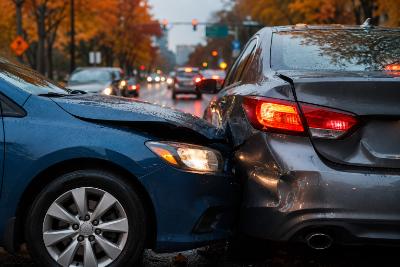
Early fall can bring several driving patterns together at the same time. School traffic is active, commuters are traveling during regular work hours, and afternoon or evening trips may overlap with practices, events, shopping, and other local travel.
In Atlanta, drivers may already be dealing with frequent merging, lane changes, congestion, and sudden slowdowns. These conditions can leave less room for error when the vehicle ahead stops unexpectedly.
Common factors in rear-end crashes can include:
- Following another vehicle too closely
- Looking at a phone, navigation screen, passenger, or object inside the vehicle
- Accelerating toward traffic that is already slowing
- Changing lanes into a gap that does not leave enough stopping distance
- Driving too fast for traffic or road conditions
- Failing to notice brake lights or stopped vehicles
- Assuming traffic will continue moving through an intersection
- Becoming impatient in a line of slow-moving vehicles
Early fall does not make Georgia roads unsafe by itself. The risk can rise when traffic patterns demand frequent braking and quicker reactions, but a driver fails to adjust speed, attention, or following distance.



Georgia Law Requires a Reasonable and Prudent Following Distance
O.C.G.A. § 40-6-49 states that a driver must not follow another vehicle more closely than is reasonable and prudent, taking into account the speed of the vehicles, traffic, and highway conditions.
Georgia law does not set one fixed number of feet that applies to every driving situation. The amount of space needed can change with speed, congestion, visibility, weather, and roadway conditions.
For example, a driver moving through open traffic may have more time to react than a driver approaching a congested interstate exit or a line of vehicles near a busy Atlanta intersection.
The Georgia Department of Driver Services also advises motorists to maintain enough distance to stop safely if the vehicle ahead slows or stops suddenly.
A rear-end impact is evidence that should be investigated, not automatic proof that the following driver is legally responsible.
Georgia appellate courts have stated that the mere fact that one vehicle strikes another from behind does not, by itself, establish negligence. Liability depends on the evidence concerning negligence, ordinary care, and what caused the collision.
Why Stop-and-Go Traffic Creates a Rear-End Crash Hazard
Stop-and-go traffic can require repeated acceleration and braking over short distances. A driver may begin moving, travel only a few car lengths, and then need to stop again.
A brief distraction can become significant when the gap between vehicles is already small.
Consider a typical Atlanta traffic situation. Vehicles begin moving near an interstate ramp or crowded intersection. A driver accelerates and then looks at a navigation screen. Traffic ahead stops again. By the time the driver looks forward, there may not be enough room to avoid a collision.
A low-speed crash can still result in vehicle damage and physical injuries. The seriousness of an injury depends on the facts of the collision and the person involved.
Drivers should treat slow traffic as a condition that requires close attention. Congestion can change quickly, even when vehicle speeds are low.
I had the pleasure of working against Chris on a fairly complicated case. Chris was professional during the course of litigation, and undoubtedly maintained his clients’ interests as the primary focus throughout. Due to Chris’ efficiency and advocacy for his clients, we were able to resolve the case for a reasonable amount, without spending unnecessary time and expenses. I hope to have more cases with Chris in the future, and would have no hesitation recommending Chris to handle complex personal injury matters.” - Paul T.
Distracted Driving Can Contribute to Rear-End Collisions
A rear-end collision may occur because the following driver does not notice that traffic has slowed or stopped.
Potential distractions can include:
- A navigation app
- A phone call or message
- A passenger
- Food or drinks
- Vehicle controls
- Searching for an address, driveway, or parking entrance
- Looking at activity outside the vehicle
- Reaching for an object
Whether a distraction proves negligence depends on the facts and the available evidence.
Evidence may include witness statements, dash camera recordings, surveillance footage, vehicle data, photographs, phone records when lawfully available, and statements made after the collision.
If you can do so safely after a crash, preserve photographs, video, witness information, and other records as soon as possible. Learn more about evidence in Georgia car accident claims:
https://gunnelslaw.com/collecting-evidence-in-a-car-accident-claim/
Dealing with Insurance Steps to File a LawsuitRelated Videos
Rear-End Collisions Can Cause Significant Injuries
The severity of a rear-end collision is not determined by vehicle damage alone. Speed, vehicle size, angle of impact, occupant position, restraint use, and individual medical factors can affect the outcome.
Injuries reported after motor vehicle collisions can include:
- Neck injuries
- Back injuries
- Concussions and other head injuries
- Shoulder injuries
- Knee injuries
- Fractures
- Soft-tissue injuries
Some injuries may be apparent at the scene, while other symptoms may become more noticeable later.
If you develop pain, dizziness, headaches, numbness, limited movement, or other symptoms after a collision, seek medical attention appropriate for your condition. Medical records can also document when symptoms were reported, what treatment was recommended, and how the injury affected your daily activities.
What Evidence Can Matter After a Rear-End Crash?
A rear-end collision claim may appear straightforward at first, but disputes can arise over how the crash occurred, whether another driver contributed to it, whether the collision caused the claimed injuries, and what losses are supported by the evidence.
Evidence that may help explain the crash and its effects includes:
- Photographs of vehicle damage
- Photographs showing vehicle positions and the roadway
- Police reports
- Witness names and contact information
- Dash camera recordings
- Traffic, business, or residential surveillance video
- Medical records and bills
- Repair estimates
- Wage-loss records
- Insurance information
- Records of treatment recommendations and follow-up care
If the collision happened during heavy traffic, photographs or video showing congestion, lane configuration, traffic signals, road work, or other temporary conditions may help establish what drivers faced at the time.
Evidence can become harder to obtain as time passes. Vehicles may be repaired, road conditions may change, witnesses may become difficult to locate, and some video systems may overwrite recordings.
Georgia Comparative Fault Can Affect a Rear-End Collision Claim
Fault in a rear-end collision is not always assigned entirely to one driver.
Under O.C.G.A. § 51-12-33, if an injured person is partly responsible for the injury or damages, the amount of damages awarded can be reduced according to that person’s percentage of fault. The statute also states that a plaintiff who is 50 percent or more responsible cannot receive damages.
For example, evidence might show that a following driver failed to leave enough space while another driver made an unsafe lane change immediately before braking. The result would depend on the evidence showing what each driver did and how those actions contributed to the crash.
After a collision, give law enforcement accurate information about what you observed. Avoid guessing about speed, distance, phone use, or other facts that you did not personally observe.
Dealing with an Insurance Company After a Rear-End Accident
Insurance adjusters may begin requesting information soon after a rear-end crash.
An insurer may ask for:
- A recorded statement
- Medical records or authorizations
- Photographs
- Repair estimates
- Employment information
- Details about prior medical history
- A description of how the collision occurred
You should provide any notice required under your own policy. Before giving a detailed recorded statement to another driver’s insurer or signing a broad medical authorization, consider obtaining legal advice about what is being requested and how it may affect your claim.
Your injuries and financial losses may not be fully known immediately after the collision. A settlement should be reviewed carefully because signing a release can end the claim covered by that agreement.
Learn more about insurance issues after an accident:
https://gunnelslaw.com/dealing-with-insurance-companies/
What Compensation May Be Available After a Georgia Rear-End Collision?
The compensation available after a rear-end collision depends on the evidence, fault, insurance coverage, injuries, and losses caused by the crash.
A claim may include compensation for supported losses such as:
- Medical expenses
- Reasonably necessary future medical care
- Lost wages
- Reduced earning capacity
- Pain and suffering
- Vehicle damage
- Other documented accident-related losses
There is no standard settlement amount for a rear-end collision. A person who recovers after limited treatment may have a very different claim from a person who needs surgery, misses significant time from work, or develops lasting limitations.
For more information about Georgia car accident claims, visit:
https://gunnelslaw.com/atlanta-car-accident-lawyer/
If the collision caused a traumatic brain injury, see our guide to factors that affect a traumatic brain injury settlement. The guide discusses evidence and losses; it cannot predict the value of an individual claim.
What Should You Do After a Rear-End Collision in Atlanta?
Your safety and medical needs should come first.
When circumstances allow, consider these steps:
- Move out of active traffic when it is safe and lawful to do so.
- Call 911 and request medical assistance when needed.
- Exchange driver and insurance information.
- Photograph the vehicles, roadway, traffic controls, and visible damage.
- Obtain names and contact information from witnesses.
- Seek medical evaluation for injuries or symptoms.
- Notify your insurer as required by your policy.
- Save medical bills, repair records, wage records, photographs, and insurance correspondence.
- Avoid arguments about fault at the roadside.
- Keep copies of police information, video, photographs, and insurance documents in a secure location.
Preserving evidence early can help establish how the crash happened and what losses followed.
How Can an Atlanta Car Accident Attorney Help After a Rear-End Crash?
A rear-end collision claim can involve more than showing that one vehicle struck another.
A car accident attorney may:
- Investigate the sequence of events
- Request available surveillance or traffic video
- Interview witnesses
- Review photographs and police records
- Obtain and review insurance information
- Evaluate evidence of distraction or unsafe following distance
- Review medical documentation
- Address comparative fault arguments
- Communicate with insurance companies
- Evaluate settlement offers
- File a lawsuit when litigation is appropriate
Gunnels Law Firm, LLC represents injured people in Atlanta, Georgia, and nearby areas. Christopher D. Gunnels spent the first 10 years of his legal career representing individuals and businesses, as well as their insurance companies, before focusing his practice on representing injured people.
Learn more about Christopher D. Gunnels:
https://gunnelslaw.com/attorney-christopher-d-gunnels/
You can learn more about the firm’s broader personal injury practice at:
https://gunnelslaw.com/personal-injury-attorney-atlanta-ga/
Frequently Asked Questions About Georgia Rear-End Collisions
Is the Rear Driver Always at Fault in Georgia?
No. A rear-end impact does not automatically establish negligence or liability. Evidence about following distance, braking, traffic conditions, lane changes, distraction, and the conduct of each driver can affect the fault analysis.
How Close Can You Legally Follow Another Vehicle in Georgia?
Georgia law does not establish one fixed following distance for every passenger vehicle in every situation. O.C.G.A. § 40-6-49 requires a following distance that is reasonable and prudent based on speed, traffic, and highway conditions.
Can I Recover Compensation if I Was Partly at Fault?
Potentially. Under Georgia’s comparative fault statute, damages can be reduced by your percentage of fault. A plaintiff who is 50 percent or more responsible cannot receive damages under O.C.G.A. § 51-12-33.
Should I Accept an Early Insurance Settlement After a Rear-End Crash?
Review the offer, your medical condition, documented losses, available coverage, and the release terms before making a decision. Once you sign a release and settle the covered claim, you may lose the ability to seek additional compensation under that claim.
Speak with an Atlanta Car Accident Attorney About a Rear-End Collision
If you were injured in a rear-end collision in Atlanta, Georgia, you may be dealing with medical treatment, missed work, vehicle repairs, and insurance questions at the same time.
Gunnels Law Firm, LLC can review the crash, explain the insurance and legal issues that may apply, and help you understand your options. Christopher D. Gunnels brings experience from the first 10 years of his legal career representing individuals, businesses, and their insurance companies, which can provide useful perspective when evaluating an injury claim.
Call (770) 766-4484 or visit:
https://gunnelslaw.com/contact-us/
Gunnels Law Firm, LLC serves injured people in Atlanta, Georgia, and nearby areas.
This article is for informational purposes only and is not legal advice. Consult an attorney about your specific situation.