
August changes traffic patterns around Georgia schools and college campuses. Classes resume, school buses return to regular routes, parents restart drop-off and pickup routines, and college students begin moving between dorms, parking areas, classrooms, restaurants, and transit stops.
In Atlanta, Georgia, these overlapping traffic patterns can place pedestrians, drivers, cyclists, and scooter riders close together during some of the busiest parts of the day.
If you are injured as a pedestrian, questions about right of way, driver negligence, your actions before the collision, available insurance coverage, and evidence can affect your claim. Georgia also uses modified comparative negligence rules, which means your percentage of fault can affect your ability to recover damages. Gunnels Law Firm, LLC helps injured pedestrians understand their legal options after a collision. The firm confirms that it handles Atlanta pedestrian accident claims and offers free consultations.





Why August Creates More Pedestrian Risk Around Georgia Schools 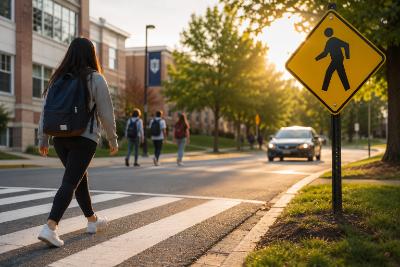
August brings a major shift in traffic patterns throughout Georgia. Roads that may have had lighter school-related traffic during summer begin carrying buses, parents, students, teachers, staff members, and other drivers at the same times each day.
Students return to elementary schools, middle schools, high schools, colleges, and universities. Parents begin driving children to school again. Buses stop along neighborhood roads. College students walk between parking areas and campus buildings. Employees return to school facilities. Ride-share and delivery vehicles may also be active near college campuses.
These conditions can require drivers to monitor several potential hazards at once.
A driver approaching a school may need to watch for:
- Changing school-zone speed limits
- Vehicles entering or leaving pickup lines
- School buses stopping ahead
- Cars entering from side streets
- Students approaching crosswalks
- Cyclists and scooter riders
- Pedestrians walking between parked vehicles
- Vehicles turning into school or campus entrances
At the same time, a child, student, parent, or employee may enter a crosswalk or cross an entrance used by vehicles.
When vehicles and pedestrians are close together, a brief loss of attention can lead to a serious pedestrian accident.
School Arrival and Dismissal Periods Can Be Especially Busy
The beginning and end of the school day can concentrate many vehicles and pedestrians into a relatively short period.
Morning activity may include:
- School buses stopping to pick up students
- Parents entering and leaving school property
- Students walking from nearby neighborhoods
- Crossing guards assisting children
- Commuters traveling through the same area
- Cyclists and scooter riders traveling to school
- Vehicles turning into parking lots and side streets
Afternoon dismissal can create another period of concentrated activity. Students may leave school in several directions. Some board buses. Others walk home, meet parents, cross streets, or leave for after-school activities.
Drivers who regularly traveled a particular Atlanta road during summer may also encounter different traffic conditions once classes resume.
The physical road may remain the same, but the number of people using it and the way traffic moves around it can change considerably.


College Campuses Present Different Pedestrian Hazards
College and university areas can create their own pedestrian risks during August.
New students may not know the campus layout. Parents may drive through the area for the first time while helping students move into residence halls. Students may search for classrooms, parking facilities, or campus entrances. Vehicles may stop near dormitories, parking areas, sidewalks, or building entrances.
College areas can include a mixture of:
- Pedestrians
- Passenger vehicles
- Bicycles
- Electric scooters
- Campus buses
- Ride-share vehicles
- Delivery vehicles
- Visitors searching for parking
- Students crossing between buildings
A student may cross several roads during an ordinary day while traveling between a parking deck, classroom, dining facility, library, transit stop, and residence hall.
Drivers near campuses should watch carefully for pedestrians at intersections, crosswalks, parking lot entrances, campus entrances, and other locations where people regularly cross.
Georgia Crosswalk Laws Can Affect Pedestrian Accident Claims
Georgia law establishes rules for both drivers and pedestrians at crosswalks.
O.C.G.A. § 40-6-91 generally requires a driver to stop and remain stopped for a pedestrian in a crosswalk under circumstances described by the statute. The law also prohibits a driver from overtaking and passing another vehicle that has stopped at a crosswalk to allow a pedestrian to cross.
That rule can be especially relevant near schools and campuses.
For example, one driver may stop because a student is crossing. A driver approaching from behind may not immediately see the pedestrian. Passing the stopped vehicle can place the pedestrian in danger.
Pedestrians also have legal responsibilities. A pedestrian should not suddenly leave a curb or other place of safety and move into the path of a vehicle that is so close that the driver cannot reasonably stop.
The circumstances surrounding a collision matter. Crosswalk location, traffic-control devices, vehicle speed, visibility, witness accounts, and the actions of both the driver and pedestrian can affect how liability is evaluated.
Learn more about Atlanta pedestrian accident claims:
https://gunnelslaw.com/atlanta-pedestrian-accident-lawyer/
The firm’s current pedestrian accident page also identifies modified comparative negligence as a factor that can affect a pedestrian injury claim.
I had the pleasure of working against Chris on a fairly complicated case. Chris was professional during the course of litigation, and undoubtedly maintained his clients’ interests as the primary focus throughout. Due to Chris’ efficiency and advocacy for his clients, we were able to resolve the case for a reasonable amount, without spending unnecessary time and expenses. I hope to have more cases with Chris in the future, and would have no hesitation recommending Chris to handle complex personal injury matters.” - Paul T.
Can a Pedestrian Be Partially at Fault for an Accident?
Yes. A pedestrian accident claim is not automatically decided against a driver simply because a vehicle struck someone who was walking.
Insurance companies may investigate what both the driver and pedestrian were doing before the collision.
Questions about the pedestrian may include whether the person:
- Used an available crosswalk
- Followed traffic signals
- Entered the roadway unexpectedly
- Was distracted
- Crossed outside an intersection
- Was visible to approaching motorists
The driver’s conduct also requires investigation.
Evidence may indicate that a driver was:
- Speeding
- Distracted
- Making an unsafe turn
- Failing to yield
- Driving too fast for existing conditions
- Failing to maintain an appropriate lookout
Georgia follows a modified comparative negligence system. If an injured person is less than 50 percent responsible, damages can generally be reduced according to that person’s percentage of fault. A plaintiff who is 50 percent or more responsible cannot recover damages under the comparative-fault rule described by Georgia authorities.
Being accused of contributing to an accident does not automatically establish fault. Liability should be evaluated using available evidence.
Learn more about partial-fault pedestrian claims:
https://gunnelslaw.com/partial-fault-pedestrian-accident/
The firm’s partial-fault pedestrian resource is currently active.
Evidence Near Schools and Colleges Can Disappear
Pedestrian accidents near schools and campuses may create several sources of evidence. Some may only remain available for a limited period.
A school, university, apartment building, restaurant, parking facility, residence, or nearby business may have cameras. Buses may have onboard video. Nearby homes may have doorbell cameras. Other vehicles may contain dash cameras.
Potential evidence may include:
- Police reports
- Photographs of the collision location
- Crosswalk markings
- School-zone signs
- Traffic signals
- Witness statements
- Surveillance footage
- Campus security footage
- Bus camera footage
- Vehicle damage
- Medical records
- Cell phone records when legally obtainable
- Vehicle electronic data when relevant
Video may be particularly useful when accounts of the accident differ.
Some recording systems automatically overwrite older footage. Witnesses can also become more difficult to locate as school schedules, class schedules, and work routines change.
Evidence can become harder to obtain with time. Identifying and preserving relevant evidence early may help establish what happened.
Learn about mistakes that may affect a pedestrian accident claim:
https://gunnelslaw.com/mistakes-to-avoid-after-a-pedestrian-accident/
That pedestrian accident resource is currently active on the firm’s website.
Dealing with Insurance Steps to File a LawsuitRelated Videos
What Should You Do After a Pedestrian Accident?
Your health should be the first concern after a pedestrian collision.
Pedestrians do not have the physical protection provided by a passenger vehicle. Even when you remain conscious or can walk after an accident, you may have injuries that require medical evaluation. The firm’s pedestrian accident guidance also advises injured pedestrians to obtain medical attention and explains why medical documentation can matter to a claim.
Depending on the circumstances, useful steps may include:
- Call 911 and report the collision.
- Seek appropriate medical attention.
- Obtain the driver’s identifying and insurance information.
- Photograph the roadway, crosswalk, traffic signals, vehicle, and surrounding area when you can do so safely.
- Obtain contact information from witnesses.
- Tell your medical providers about your symptoms.
- Follow your medical provider’s treatment instructions.
- Save medical bills, receipts, and employment records related to your injuries.
- Avoid making assumptions about who was legally at fault.
- Use caution before providing a recorded statement to an insurance company.
- Preserve photographs, video, messages, and other records connected with the accident.
A police report does not by itself determine liability in a civil injury claim. It can preserve useful information about the collision, including the parties involved, location, witnesses, and observations recorded at the scene.
What Compensation May Be Available After a Pedestrian Accident?
The damages available in a pedestrian accident claim depend on the facts of the case.
Depending on the injuries and supporting evidence, a claim may involve losses associated with:
- Emergency medical treatment
- Hospital care
- Surgery
- Physical therapy
- Prescription medication
- Lost wages
- Reduced earning capacity
- Future medical treatment
- Pain and suffering
- Permanent impairment
- Scarring or disfigurement
Insurance coverage and questions of liability can also affect a claim.
When injuries have long-term consequences, evaluating damages may require consideration of future medical care, work restrictions, and lasting physical limitations.
A responsible case evaluation requires information about the accident, medical treatment, available evidence, insurance coverage, and liability. A specific settlement amount cannot be determined from the fact that a pedestrian accident occurred.
Learn more about factors that may affect pedestrian accident case value:
https://gunnelslaw.com/pedestrian-accident-case-value/
The firm’s pedestrian accident case-value resource is currently active.
How Can an Atlanta Pedestrian Accident Attorney Help?
A pedestrian accident claim can require more investigation than obtaining a police report and submitting medical bills.
Depending on the case, an attorney may:
- Review the circumstances surrounding the collision
- Examine available photographs and video
- Identify and contact witnesses
- Request surveillance footage
- Review medical documentation
- Communicate with insurance companies
- Analyze allegations of comparative fault
- Identify potentially available insurance coverage
- Document damages supported by evidence
- Evaluate whether additional records or expert analysis may be needed
When an accident occurs near a school or college, an investigation may also include determining whether cameras, reports, or other records are maintained by a school, university, transportation provider, nearby business, or property owner.
An attorney can also evaluate an insurance company’s assertion that the pedestrian caused or contributed to the collision.
Gunnels Law Firm, LLC is based in Atlanta, Georgia, and handles personal injury matters that include pedestrian accident cases. Its website currently offers free consultations and identifies Christopher D. Gunnels as an Atlanta pedestrian accident lawyer.
Learn more about Christopher D. Gunnels:
https://gunnelslaw.com/attorney-christopher-d-gunnels/
Why August Pedestrian Awareness Matters
August does not mean that every Georgia school zone or college campus is unsafe. The concern is the change in the number and movement of pedestrians and vehicles once school-year activity resumes.
A road with relatively little school-related pedestrian traffic during summer can become much busier after classes begin.
Drivers can reduce risks by:
- Slowing down around schools and campuses
- Watching carefully before making turns
- Checking crosswalks before proceeding
- Looking for pedestrians near parked vehicles
- Allowing additional travel time
- Avoiding distracted driving
- Following school-zone traffic controls
Pedestrians can also take precautions by:
- Using crosswalks when available
- Obeying pedestrian signals
- Staying visible to drivers
- Watching for turning vehicles
- Avoiding sudden movements into traffic
- Remaining attentive while crossing streets and entrances
Precautions cannot prevent every collision. When an accident does occur, determining what happened and preserving supporting evidence may become central parts of an injury claim.
Speak With an Atlanta Pedestrian Accident Lawyer
If you or a family member was injured while walking near a school, college campus, crosswalk, bus stop, or roadway in Atlanta, Georgia, Gunnels Law Firm, LLC can review the circumstances and explain legal options that may be available.
An early investigation may help identify video, witnesses, photographs, and other evidence before those materials become more difficult to obtain.
Gunnels Law Firm, LLC offers free consultations. Call 770-766-4484 or contact the firm online:
https://gunnelslaw.com/contact-us/
The firm’s contact page and pedestrian accident page currently confirm its Atlanta contact information and free-consultation offering.
This article is for informational purposes only and does not constitute legal advice. Consult an attorney about the facts of your specific situation.