
Summary
Yes, sun glare can affect how fault is evaluated after a Georgia car accident, but bright sunlight does not automatically excuse a driver who causes a collision. Drivers are expected to use reasonable care under the conditions they face. When glare limits visibility, that may require slowing down, increasing following distance, using a sun visor, or stopping in a safe location if continuing would be unsafe.
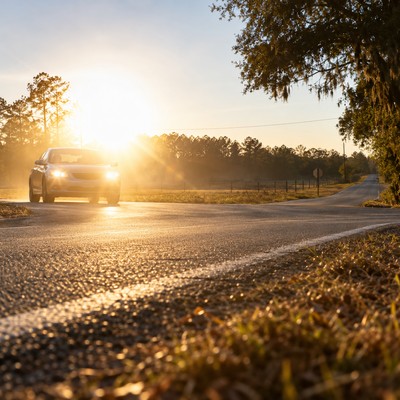
In Atlanta, GA, low morning or evening sunlight can make traffic signals, brake lights, pedestrians, bicyclists, lane markings, and nearby vehicles harder to see. After a crash, investigators and insurance companies may look closely at what each driver could see and how each person responded to the reduced visibility.
If you were injured in a crash where sun glare may have contributed to the collision, Gunnels Law Firm, LLC can review the available evidence and explain how Georgia fault rules may apply.




Why Sun Glare Can Become a Fault Issue
Sun glare can reduce a driver's ability to see clearly within seconds. The problem can become more noticeable when the sun sits low on the horizon during morning or evening travel.
A driver facing bright sunlight may have difficulty seeing:
- Traffic lights and stop signs
- Brake lights on vehicles ahead
- Lane markings
- Pedestrians and bicyclists
- Vehicles entering an intersection
- Stopped or slowing traffic
- Road hazards
Glare can also reflect from windshields, mirrors, buildings, and road surfaces.
The existence of glare does not determine fault by itself. The main question is usually whether each driver acted reasonably under the conditions present at the time of the crash.
Key point: Sun glare may explain why visibility was reduced, but it does not automatically excuse unsafe driving.



Does Sun Glare Excuse a Driver Who Causes an Accident?
No. Sun glare is not an automatic defense to responsibility for a crash.
Georgia drivers must operate their vehicles at a speed that is reasonable and prudent under the conditions and must reduce speed when special hazards exist. Reduced visibility from bright sunlight can be part of that analysis.
Consider a driver approaching an Atlanta intersection while facing intense evening sunlight. The driver realizes that the traffic signal is difficult to see but continues through the intersection without slowing down. If the vehicle strikes another car that had the right of way, the fact that sunlight blocked the driver's view would not necessarily eliminate responsibility.
The glare may help explain why the driver did not see the signal. The driver's decision to continue without adjusting to the reduced visibility may still be relevant when fault is evaluated.
A driver who is struggling to see may need to slow down, create more distance from other vehicles, use a visor, change position when it can be done safely, or stop in a safe place until visibility improves.
For more information about how liability is evaluated after a crash, visit:
https://gunnelslaw.com/atlanta-car-accident-lawyer/
Georgia Comparative Fault and Sun Glare Accidents
Fault is not always limited to one person.
Georgia follows a modified comparative fault rule. Under O.C.G.A. § 51-12-33, an injured person's damages can be reduced in proportion to that person's share of fault. If the injured person is 50 percent or more responsible, that person generally cannot recover damages from another party.
That rule can matter in a sun glare accident.
Suppose one driver says that sunlight prevented the driver from seeing a vehicle ahead. The other driver may also face allegations of changing lanes unsafely, failing to yield, stopping in an unsafe manner, or committing another act that contributed to the collision.
Sunlight does not establish either driver's percentage of responsibility. The available evidence must be examined to determine how each person's conduct contributed to the crash.

I had the pleasure of working against Chris on a fairly complicated case. Chris was professional during the course of litigation, and undoubtedly maintained his clients’ interests as the primary focus throughout. Due to Chris’ efficiency and advocacy for his clients, we were able to resolve the case for a reasonable amount, without spending unnecessary time and expenses. I hope to have more cases with Chris in the future, and would have no hesitation recommending Chris to handle complex personal injury matters.”
- Paul T.
Evidence Can Be Critical in a Sun Glare Accident
Glare conditions can change quickly. The sun continues moving, traffic clears, weather conditions shift, and damaged vehicles may be removed from the scene.
By the time an insurance adjuster reviews the collision days or weeks later, the roadway may no longer reflect what the drivers experienced at the exact time of impact.
Evidence collected shortly after the crash can help show what happened.
Potentially useful evidence may include:
- Photographs of the roadway and direction of travel
- Photographs showing the sun's position
- Dashboard camera footage
- Traffic camera recordings
- Nearby surveillance video
- Witness statements
- Police crash reports
- Vehicle damage
- Skid marks and debris
- Traffic signal information
- Vehicle event data when available
- Weather and visibility information
If it can be done safely, photographs taken in the direction each vehicle was traveling may be useful. They can help show whether sunlight was directly within a driver's field of vision.
Learn more about preserving evidence after a Georgia car accident:
https://gunnelslaw.com/collecting-evidence-in-a-car-accident-claim/
Can Driving Too Fast for Visibility Affect Fault?
Yes. A posted speed limit does not mean that driving at that speed is reasonable under every condition.
Georgia law requires drivers to use a reasonable and prudent speed under the circumstances. A driver may need to reduce speed when weather, traffic, road conditions, or another hazard makes normal travel unsafe. Bright sunlight that sharply reduces visibility can become part of that analysis.
For example, consider a driver following another vehicle while looking directly toward the setting sun. If the driver can barely see the vehicle ahead but maintains the same speed and following distance, the driver may have too little time to react when traffic slows.
A rear-end collision could result.
An insurance investigation may look at:
- Vehicle speed
- Following distance
- Braking
- Lane position
- The direction of travel
- The sun's position
- Driver statements
- Photographs or video
- Witness accounts
Sun glare may have contributed to the collision, but the driver's choices can still affect the negligence analysis.
What If Both Drivers Were Facing Sun Glare?
Two drivers can experience similar visibility problems while responding to them differently.
One driver may reduce speed and increase following distance. Another may maintain speed or change lanes without being able to see whether the neighboring lane is clear.
Investigators may compare:
- Each vehicle's direction of travel
- The exact time of the accident
- Road orientation
- Vehicle speed
- Following distance
- Lane position
- Driver statements
- Witness accounts
- Photographs and video
The fact that both drivers experienced glare does not mean fault must be divided equally.
Liability depends on each person's conduct and whether that conduct contributed to the collision.
Can an Insurance Company Use Sun Glare Against You?
An insurance company may consider sun glare when deciding whether to accept, deny, or dispute a claim.
An adjuster may ask whether the sun was in your eyes, whether you could see the vehicle ahead, whether you used your visor, or whether you reduced your speed.
Your answers may become part of the insurer's liability analysis.
For example, telling an adjuster that you could not see the road for several seconds but continued driving at the same speed may lead to questions about whether you used reasonable care.
That does not mean the insurance company's position is automatically correct. The other driver's actions and the physical evidence must also be considered.
Another motorist may have run a traffic signal, followed too closely, entered your lane, failed to yield, or taken another action that contributed to the collision. A proper investigation should consider all relevant circumstances rather than focusing on one statement about sunlight.
For more information about communicating with insurance companies after an injury claim, visit:
https://gunnelslaw.com/dealing-with-insurance-companies/
What Should You Do After a Sun Glare Accident in Atlanta?
Safety and medical needs should come first.
Call 911 and request emergency assistance when needed. Move to a safe location if you can do so without creating another hazard.
After immediate safety concerns have been addressed, preserve as much information as reasonably possible.
You may want to:
- Photograph the vehicles and visible damage
- Photograph the roadway, intersection, traffic controls, and surrounding area
- Photograph the direction of the sunlight from a safe position
- Record the approximate time of the collision
- Ask witnesses for their names and contact information
- Save dashboard camera footage before the system overwrites it
- Keep medical bills, treatment records, prescription receipts, repair estimates, and records of missed work
- Avoid guessing about facts that you do not know
The time of the collision can be especially useful because the sun's position changes throughout the day. A neutral witness may also be able to describe whether a driver appeared to be speeding, following too closely, or failing to react before impact.
If you are uncertain about your speed, distance, or what another driver could see, state only what you know. An assumption can later conflict with photographs, video, vehicle data, or witness statements.
How an Atlanta Car Accident Attorney Can Help
Sun glare accidents can become disputed when drivers and insurance companies disagree about why the collision happened.
An attorney can review the available evidence instead of relying only on competing driver statements. That review may include photographs, police reports, video footage, witness accounts, medical records, vehicle damage, traffic information, and other evidence connected to the crash.
Legal counsel can also evaluate Georgia's comparative fault rules and address allegations that an injured person shares responsibility for the collision.
The goal is to determine what the evidence supports and how Georgia law applies to the specific facts.
Talk With an Atlanta Car Accident Attorney
If you were injured in a car accident in Atlanta, Georgia, or a nearby area, Gunnels Law Firm, LLC can review the circumstances and explain your legal options. Attorney Christopher D. Gunnels has experience handling personal injury and liability matters and can evaluate evidence that may affect fault in your claim.
Contact the firm online for a consultation.
https://gunnelslaw.com/contact-us/
This article is for general informational purposes only and is not legal advice. Every case is different. You should consult an attorney about your specific circumstances.